
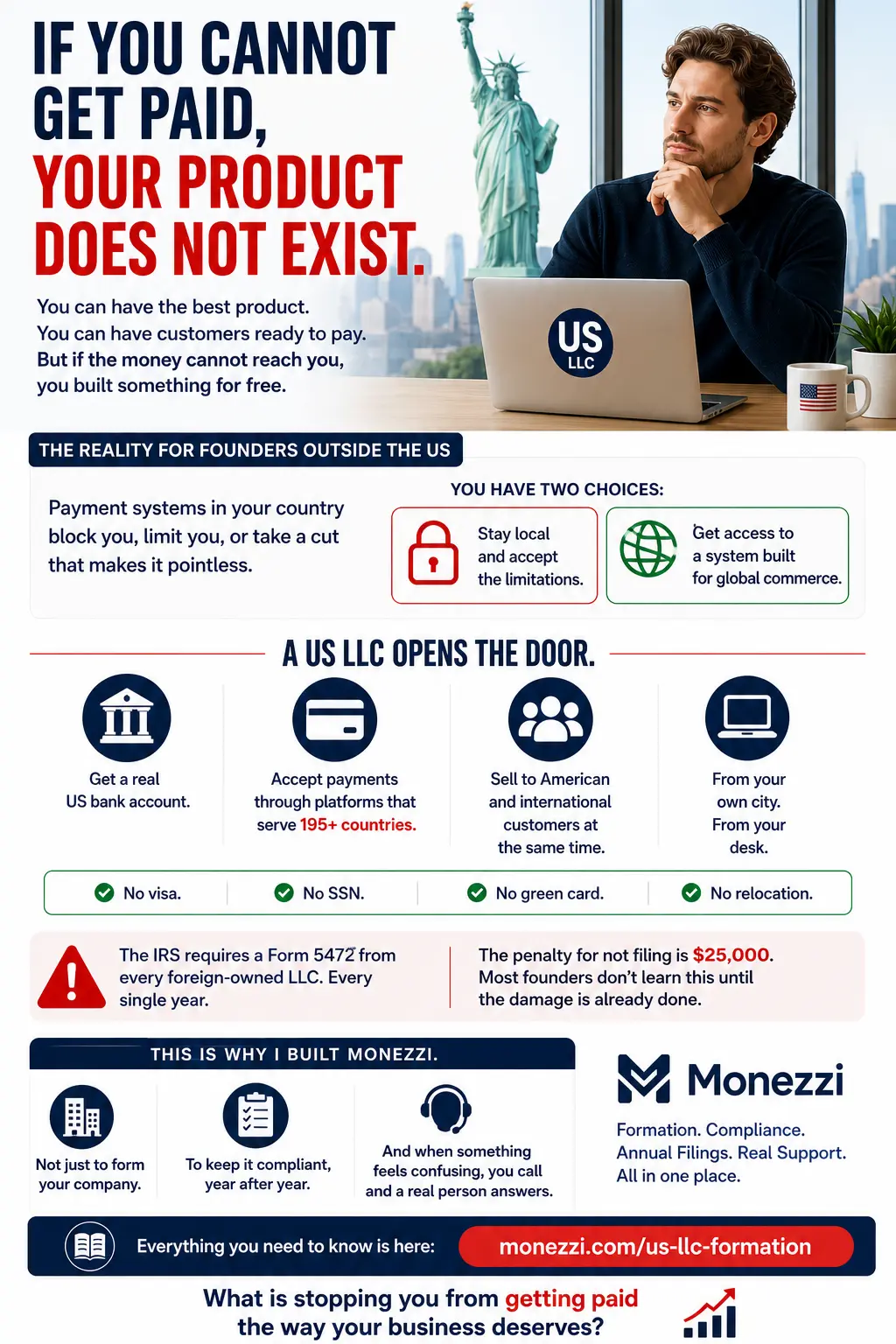
The diagnosis: revenue without infrastructure is not revenue
You have a working product. You have customers reaching out. You send invoices and the money does not arrive, or it arrives smaller than the invoice, or it arrives weeks late, or the platform freezes the payout for a review that never seems to end. You start to think the problem is the product. The problem is the route from your product to your bank account.
Currency conversion alone shaves 2 to 4 percent on most transactions. Local processors restrict the payment methods you can offer. Marketplaces and B2B vendors check your entity documentation before they onboard you. None of this is about effort. It is about which side of the global payment system you sit on.
The founders who scale past this ceiling are not better at sales. They have a US entity that gives the money somewhere to land. Everything downstream becomes possible because of that one structural decision.
What a US LLC actually unlocks
This is not a list of "benefits." These are the specific access changes that happen the day you have a US entity and a US bank account in its name.
💵 A real US bank account
Receive USD without conversion spread on the inbound side. Hold balances in USD. Pay USD vendors directly. The account is in the LLC name, not yours.
🌐 Stripe and modern processors
Most major processors that operate in 195 countries treat a US entity differently than an individual foreign account. This reduces the risk of holds and expands the payment methods you can offer customers.
🛒 Marketplace eligibility
Amazon Seller, Etsy, eBay, Walmart, Shopify Payments, and most US marketplaces require US entity documentation for full access. Your country of residence does not block you. Your entity does.
🤝 Enterprise vendor onboarding
Companies with real procurement budgets do entity verification before they cut a purchase order. A US LLC with an EIN is a checkbox they can mark. A personal foreign invoice is a friction they decline.
📈 USD-denominated reserves
You stop being a passive participant in your local currency. Revenue in USD, costs in your local currency, runway calculated in the stronger of the two. This is structural arbitrage, not a hack.
🛂 No visa, no relocation
Forming a US LLC and opening a US bank account does not require a US visa, a green card, or moving to the US. It is paperwork, not immigration.
From product to payment: the actual route
The work between "I have a customer ready to pay" and "the money is in my account" is concrete. It is not glamorous. Most founders skip steps and then wonder why payments stall.
Form a US LLC in a state that fits your business
Wyoming, Florida, Delaware, and Texas dominate the conversation, but the right answer depends on your specific business model. Read the comparison of best states before defaulting to whatever the loudest video told you.
Apply for an EIN from the IRS
Without an Employer Identification Number, you cannot open a bank account, register with payment processors, or onboard with most marketplaces. As a non-US founder you apply via Form SS-4. See the EIN for foreigners guide for the steps that actually work.
Open a US business bank account in the LLC name
Mercury, Relay, and a handful of other banks accept non-resident-owned LLCs. The account must be in the LLC name with the EIN, not in your personal name. This is the moment the routing layer goes live.
Connect payment processors to the entity
Stripe, PayPal Business, and processor-specific applications connect to the LLC and its US bank. Now the money has a clean path: customer card → processor → US bank → your USD balance.
Maintain compliance every year — this is where most founders fall
Annual state report, registered agent renewal, BOI filing with FinCEN, and the one most founders never hear about until the IRS letter arrives. See the next section.
The same idea, in plain words: a great product without a route to clean USD revenue is a hobby. The route exists. The structural fix is a US entity with proper banking and compliance maintained year over year.
Real arbitrage, not a marketing line
Costs in your local currency. Revenue in USD. Runway calculated in the stronger of the two. This is not a "hack." It is structural arbitrage that has existed for decades for companies that operate across borders. What changed in the last few years is that solo founders and small teams can access the same structure that used to require corporate lawyers and an in-house finance department.
The economics: a SaaS founder in Istanbul charging $99 per seat collects USD into a US bank, runs operating expenses in lira, and saves the conversion spread plus the platform-eligibility lift. Over a year, the structural advantage often exceeds the cost of forming and maintaining the LLC by an order of magnitude. The founders who treat the LLC as a routing layer, not a status symbol, see the math.
The trust gap with the clients worth having
The clients with real procurement budgets do entity verification. They are not deciding whether you are talented. They are deciding whether they can wire money to you cleanly under their company's vendor onboarding policy. A US LLC with an EIN passes that check. A personal foreign invoice from an individual usually does not.
Not every customer cares. The ones with the budget that moves your business forward usually do. Building for the customers worth keeping means structuring for them upfront.
Monezzi: the routing layer, set up correctly
Monezzi sets up the US entity, the EIN, and the compliance stack so the payment infrastructure stays open year over year. The Form 5472 filing is included so the $25,000 trap does not become your story. Real humans answer when something feels confusing.
Frequently asked questions
Do I need to live in the US to open a US LLC?
No. A US LLC can be formed by a non-US resident without a visa, green card, or US address. The LLC needs a registered agent with a US address — that is included in most formation services. Your personal residence stays where it is.
Will a US LLC remove all payment processor risk?
It reduces the risk of holds and expands processor eligibility. It does not eliminate processor risk entirely, because processors evaluate the business model and transaction patterns separately from the entity. A US LLC is necessary for most modern payment infrastructure. It is not sufficient on its own to guarantee zero holds.
How long does it take to start receiving payments after forming the LLC?
Formation typically completes in 1 to 3 business days for popular states. The EIN follows in 1 to 4 weeks depending on the IRS processing pace and your filing method. A US bank account can be opened within days of receiving the EIN. From decision to first payment received is commonly 2 to 6 weeks for most non-US founders.
What is Form 5472 and why does it matter so much?
Form 5472 is an annual IRS information return required for every foreign-owned single-member LLC. It must be filed by March 31 each year, alongside a pro forma Form 1120. The minimum penalty for not filing is $25,000 per form per year. The obligation exists regardless of whether the LLC had income. See the complete Form 5472 guide.
Which state should I form the LLC in?
Wyoming, Florida, Delaware, and Texas are popular for different reasons: privacy, low fees, banking-compatibility, and investor familiarity respectively. The right answer depends on your specific business model, where your customers are, and whether you need to qualify in additional states. The state comparison guide covers the trade-offs in detail.
Can I run a US LLC without a US accountant?
You can. Most foreign-owned single-member LLCs have a small set of recurring obligations: Form 5472, BOI filing, the state annual report, and the registered agent renewal. The work is procedural, not advisory. Monezzi automates these and handles the filings as part of the subscription, which is the typical setup for solo and small-team founders.
If you have a working product and customers ready to pay, the bottleneck is the route from their card to your bank, not the product. A US LLC plus a US bank plus the right compliance stack opens that route. The Form 5472 trap closes it again the moment you ignore it.
Monezzi sets up the route and keeps it open. See the pricing → or start your US entity →